
Dawei Erquan Yingyue Guitar Solo:What is Dawei Erquan Yingyue and why is it popular as a guitar solo?
Q: What is Dawei Erquan Yingyue and why is it popular as a guitar solo?
A: Dawei Erquan Yingyue refers to the famous Chinese erhu piece 'Erquan Yingyue' (Moon Reflected on Second Spring) composed by Hua Yanjun, also known as Abing. The name 'Dawei' may refer to a specific arranger or performer, such as Dawei, who created a guitar solo version. This piece is popular as a guitar solo because it beautifully translates the melancholic and evocative melodies of the original erhu composition onto the guitar. The guitar's expressive capabilities, including bending notes, vibrato, and fingerpicking techniques, allow musicians to capture the emotional depth of the erhu. Additionally, the fusion of traditional Chinese music with Western instrumentation appeals to audiences seeking cross-cultural musical experiences. The solo arrangement often highlights the guitar's versatility, making it a favorite among classical and fingerstyle guitarists. Its popularity is also fueled by the global interest in Chinese traditional music and the growing community of guitar enthusiasts exploring non-Western repertoire.
Q: How can I learn to play Dawei Erquan Yingyue as a guitar solo?
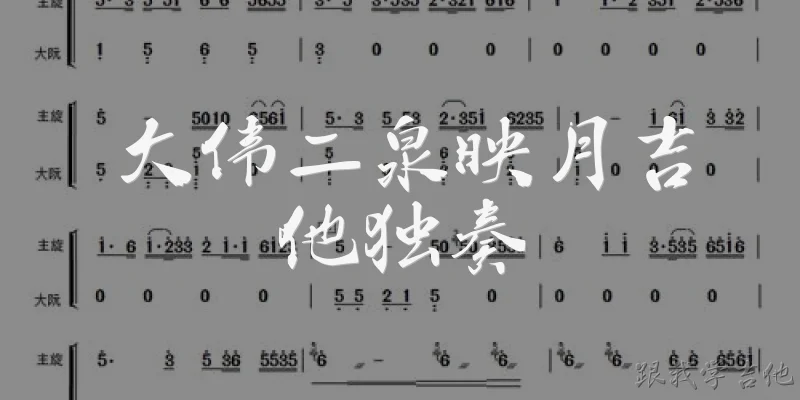
A: To learn Dawei Erquan Yingyue as a guitar solo, start by familiarizing yourself with the original erhu melody. Listen to multiple recordings to internalize the phrasing, dynamics, and emotional nuances. Next, find a reliable guitar tablature or sheet music. Many online platforms and guitar forums offer arrangements, some specifically attributed to Dawei. If you can't find a ready-made arrangement, consider transcribing it yourself by ear or using software to slow down recordings. Practice the piece slowly, focusing on accurate note placement and smooth transitions. Pay attention to techniques like hammer-ons, pull-offs, slides, and vibrato to emulate the erhu's expressive style. Since the piece is in a pentatonic scale, it's helpful to practice those scales. Break the solo into sections and master each before combining. Finally, work on dynamics and timing to convey the haunting mood. Regular practice with a metronome and recording yourself will aid progress.
Q: What are the main challenges of performing Dawei Erquan Yingyue on guitar?
A: Performing Dawei Erquan Yingyue on guitar presents several challenges. First, the piece was originally composed for the erhu, a two-stringed instrument with a distinct vocal-like quality. Capturing that expressive, singing tone on the guitar requires advanced techniques such as string bending, deep vibrato, and careful control of attack and release. Second, the melody often involves microtonal inflections and glissandi that are natural on the erhu but difficult on the guitar, which has fixed frets. Guitarists must use slides and bends to approximate these nuances. Third, the emotional depth of the piece demands mature musicality; simply playing the notes is not enough. The performer must convey a sense of melancholy and reflection. Fourth, the arrangement may require fingerstyle independence and complex chord-melody textures, especially if it's a solo guitar version. Finally, maintaining the original's pacing and rubato while ensuring clarity on the guitar can be tricky. Overcoming these challenges requires dedicated practice, a deep understanding of Chinese music aesthetics, and a willingness to experiment with techniques.
Words of experience
Common scenarios of "Dawei Erquan Yingyue Guitar Solo"
【Guitarist】 Hey, I just discovered a guitar solo arrangement of 'Erquan Yingyue' by Dawei. It's incredible!
【Music Enthusiast】 Really? I've always loved the erhu original. How does it translate to guitar?
【Guitarist】 Dawei uses fingerstyle techniques to mimic the erhu's slides and vibrato. It's hauntingly beautiful.
【Music Enthusiast】 I can imagine. The original is so emotional. Does the guitar version capture that?
【Guitarist】 Absolutely. The lower register of the guitar adds a deep, melancholic tone. You should listen to it.
【Music Enthusiast】 Is it a solo guitar piece or does it have accompaniment?
【Guitarist】 It's purely solo guitar. Dawei plays all the parts simultaneously, creating a rich texture.
【Music Enthusiast】 That's impressive. I've heard some of Dawei's other arrangements, but not this one.
【Guitarist】 He released it last year. The way he handles the harmonics in the second section is mesmerizing.
【Music Enthusiast】 I need to check it out. Is it on streaming platforms?
【Guitarist】 Yes, it's on Spotify and YouTube. The YouTube video has close-up shots of his technique.
【Music Enthusiast】 Great! I'll watch it tonight. Thanks for the recommendation.
【Guitarist】 No problem. Let me know what you think. I think it's a masterpiece.
【Music Enthusiast】 I will. By the way, does he use any effects?
【Guitarist】 Minimal. Just a touch of reverb to simulate the erhu's resonance. Mostly acoustic.
【Music Enthusiast】 That's authentic. I appreciate when arrangements stay true to the original.
【Guitarist】 Exactly. Dawei respects the source while adding his own flair.
【Music Enthusiast】 I might try to learn it myself. Is it difficult?
【Guitarist】 It's advanced. Requires good finger independence and dynamics control. But worth the effort.
【Music Enthusiast】 I'll start with the first section. Thanks again for sharing!