
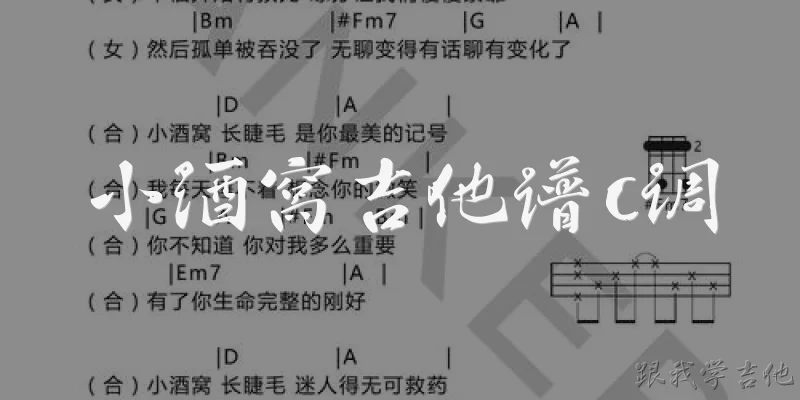
Dimple Guitar Tab in C Key:What is a Dimple Guitar Tab in C Key and how do I read it?
Q: What is a Dimple Guitar Tab in C Key and how do I read it?
A: A Dimple Guitar Tab in C Key is a six-line staff notation that shows you exactly where to place your fingers on the fretboard to play the song in the key of C major. The six horizontal lines represent the guitar strings, with the top line being the high E string and the bottom line the low E string. Numbers on each line indicate which fret to press, and a zero means play the string open. Because the song is in C key, you will mostly encounter chords like C, F, G, and Am, along with notes from the C major scale. Reading the tab is straightforward: scan from left to right, and when numbers stack vertically, pluck those strings together. Practice slowly at first to build muscle memory.
Q: What chords and scales are commonly used in a Dimple Guitar Tab in C Key?
A: In a Dimple Guitar Tab written in C major, the most common chords are the diatonic triads of the key: C major, D minor, E minor, F major, G major, A minor, and B diminished. Most pop and folk arrangements rely primarily on C, F, G, and Am because they sound pleasant and are easy to finger. The melody notes typically come from the C major scale, which consists of C, D, E, F, G, A, and B. Knowing this scale across the fretboard helps you recognize patterns in the tab and even improvise. You will also frequently see the relative minor, A minor, used for emotional contrast. If the tab includes a capo instruction, remember that the shapes correspond to the capo position while the sounding key remains C.
Q: How can a beginner practice a Dimple Guitar Tab in C Key effectively?
A: For beginners, the best way to practice a Dimple Guitar Tab in C Key is to break it into small sections, usually one or two measures at a time. Start by playing each section slowly without a metronome, focusing on clean fretting and clear picking. Once you can play a section smoothly five times in a row, move to the next. After learning all sections, connect them gradually and then increase the tempo using a metronome. Since the key of C uses many open strings and simple chord shapes, it is very beginner-friendly. Pay attention to the rhythm notations if the tab includes them; otherwise, listen to the original recording to internalize the timing. Practicing daily for fifteen to twenty minutes yields faster progress than sporadic long sessions.
Q: Why is the key of C often chosen for Dimple Guitar Tab arrangements?
A: The key of C is often chosen for Dimple Guitar Tab arrangements because it is the most natural key on the guitar for beginners and songwriters alike. It contains no sharps or flats in its scale, which means the basic chords, C, Dm, Em, F, G, Am, and Bdim, use many open strings and easy fingerings. This makes the tab accessible to players who have not yet mastered barre chords. Additionally, the open strings ring out brightly, giving the arrangement a full, resonant sound that suits the gentle, melodic style typical of Dimple songs. Transposing to C also makes it simple to add a capo on other frets if you want to match a different vocal range while keeping the same chord shapes. Overall, C major offers the best balance of simplicity and musicality.
Dialogue about
Common scenarios of "Dimple Guitar Tab in C Key"
【Guitar Teacher】 Hey, ready to start learning 'Dimple'? I've prepared a simplified arrangement in C key for you.
【Student】 Yes! I love that song. But isn't the original in a different key? Why C?
【Guitar Teacher】 The original is in B major, but C key is easier for beginners—no barre chords, and open chords sound fuller. Plus, you can capo later if you want to match the original pitch.
【Student】 That makes sense. So what chords will we use?
【Guitar Teacher】 Mostly C, G, Am, F, and sometimes Dm. The progression is quite repetitive, which is great for practice.
【Student】 Can you show me the main riff? I remember it has a catchy melody.
【Guitar Teacher】 Sure. It's based on a pentatonic scale in C. Let me tab it out: e|----------------| B|----------------| G|----------------| D|----------------| A|----------------| E|----------------| Actually, let me write it properly: e|--0--3--0-------| B|--------3--1----| G|--------------0-| etc. I'll send you a PDF later.
【Student】 Okay, I'll wait for the PDF. In the meantime, should I practice the chord changes?
【Guitar Teacher】 Yes, practice switching between C and G smoothly. Then add Am and F. Use a metronome at 60 bpm.
【Student】 Got it. What about strumming pattern?
【Guitar Teacher】 For the verse, use a simple down-down-up-up-down-up pattern. For the chorus, you can strum more energetically with eighth notes.
【Student】 I see. Is there a fingerpicking version?
【Guitar Teacher】 Absolutely. You can arpeggiate the chords: thumb plays the bass note, then fingers pluck the top three strings. It sounds beautiful for the intro.
【Student】 Can you give me the fingerpicking tab for the intro in C key?
【Guitar Teacher】 Here it is: e|-------0-------| B|---1-------1---| G|-----0-------0-| D|---------------| A|-3-------3-----| E|---------------| That's for C chord. Then move to G: e|-------3-------| B|---0-------0---| G|-----0-------0-| D|---------------| A|---------------| E|-3-------3-----|
【Student】 Thanks! That looks manageable. What about the melody line? I want to play the vocal melody on guitar.
【Guitar Teacher】 The vocal melody in C key starts on E (open first string) then goes to G (third fret), then A (fifth fret), etc. I'll tab that out for you too.
【Student】 Great. How long do you think it'll take me to learn the whole song?
【Guitar Teacher】 If you practice 30 minutes a day, you can get the chords down in a week, and the melody in another week. The fingerpicking might take a bit longer.
【Student】 Okay, I'll start with the chords today. One more thing: should I use a capo to match the original key?
【Guitar Teacher】 If you want to sing along, put a capo on the 1st fret and play in C shapes—that will sound in C#. But the original is in B, so you'd need to transpose differently. For now, just focus on C key.
【Student】 Understood. I'll practice and show you next lesson.
【Guitar Teacher】 Perfect. Don't forget to warm up with some chromatic exercises. See you then!