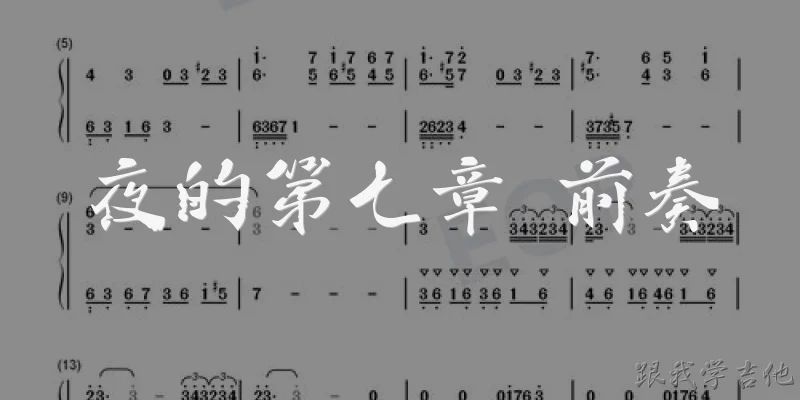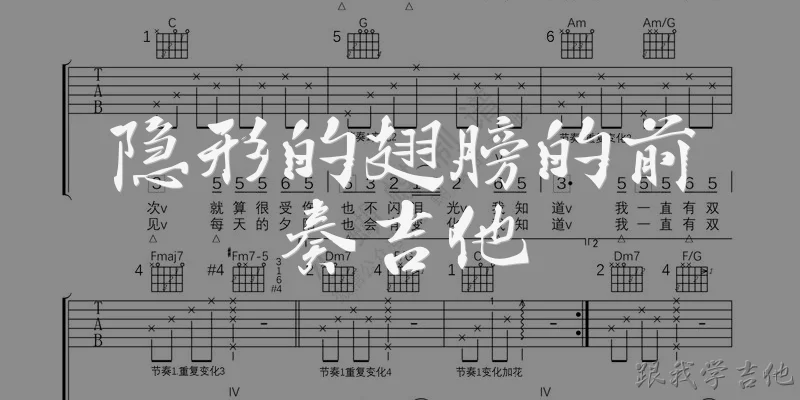
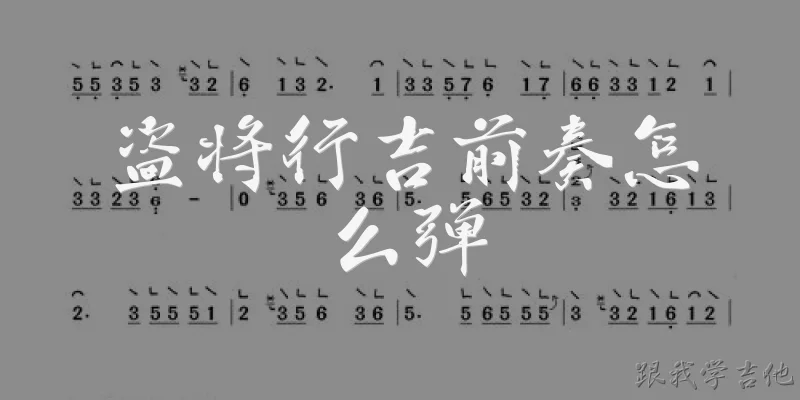
How to play the intro of Dao Jiang Xing on guitar:What guitar tuning and capo position are recommended for playing the intro of Dao Jiang Xing?
Q: What guitar tuning and capo position are recommended for playing the intro of Dao Jiang Xing?
A: For the intro of Dao Jiang Xing, standard tuning (EADGBE) is typically used, but many guitarists place a capo on the 2nd fret to match the original recording's pitch. This makes open chords like C, G, Am, and F sound higher and closer to the song's key. Alternatively, you can tune down half a step and play without a capo, but capo on 2nd fret is easier for beginners. Check the specific arrangement you're following, as some versions use drop D tuning for a heavier feel. Always tune accurately before starting.
Q: What are the basic fingerpicking patterns used in the intro of Dao Jiang Xing?
A: The intro of Dao Jiang Xing often uses a Travis-style fingerpicking pattern with the thumb playing alternating bass notes on the lower strings (E, A, D) while the index and middle fingers pluck the higher strings (G, B, e). A common pattern is thumb on beat 1 and 3, index on beat 2, middle on beat 4, but with syncopation. Practice slowly with a metronome at 60 BPM, focusing on steady thumb independence. The intro also includes hammer-ons and pull-offs on the B string, so coordinate your fretting hand smoothly. Listen to the original for phrasing.
Q: Which chords are essential for the intro of Dao Jiang Xing on guitar?
A: The intro of Dao Jiang Xing primarily uses Am, G, F, C, and sometimes Dm. A typical progression is Am - G - F - C, repeated with variations. You'll also encounter a walk-down bass line from A to G to F to E, often played on the low E and A strings. For the higher melody notes, you'll fret notes on the B and high E strings, usually at the 1st, 3rd, and 5th frets. Mastering smooth chord transitions, especially from F to C, is crucial. Practice each chord change slowly before combining them.
Q: How can I practice the rhythm and timing of the intro to Dao Jiang Xing?
A: Start by setting a metronome to 70-80 BPM, as the intro is moderate tempo. Clap or tap the rhythm first: the pattern is mostly eighth notes with occasional sixteenth-note ornaments. Count '1 and 2 and 3 and 4 and' aloud. Then play only the bass notes with your thumb, then add the melody notes on the higher strings. Record yourself and compare to the original. Focus on consistent timing of the hammer-ons—they should land exactly on the beat or offbeat as notated. Gradually increase speed to 100 BPM once comfortable.
Q: What are common mistakes beginners make when playing the intro of Dao Jiang Xing?
A: Common mistakes include rushing the tempo, especially during the pull-off sections, and neglecting the alternating bass line by playing all notes with equal volume. Another error is fretting the F chord with a buzzy barre; try using a simplified F (xx3211) or capo higher. Many beginners also forget to let notes ring—the intro relies on overlapping sustain. Additionally, they often ignore the dynamic contrast: the intro should start soft and build slightly. Practice slowly with a metronome, and isolate difficult transitions like Am to G to F. Record yourself to catch timing issues.
Words of experience
Common scenarios of "How to play the intro of Dao Jiang Xing on guitar"
【Guitar Novice】 Hey, I've been trying to learn the intro of 'Dao Jiang Xing' on guitar, but I'm stuck. Can you help me?
【Guitar Teacher】 Sure! 'Dao Jiang Xing' is a beautiful piece. The intro is quite melodic. Do you know which version you're trying to play? There are several arrangements.
【Guitar Novice】 I think it's the original version by the composer. It's in standard tuning, right?
【Guitar Teacher】 Yes, standard tuning is common. The intro often starts with a fingerpicking pattern. Are you familiar with Travis picking or similar techniques?
【Guitar Novice】 I know basic fingerpicking, but not Travis picking. Maybe that's why I'm struggling.
【Guitar Teacher】 That could be it. Let's break it down. The first few bars are in the key of C major, I believe. Do you have the tablature?
【Guitar Novice】 I found some tabs online, but they seem inconsistent. Some say capo on 2nd fret, others don't.
【Guitar Teacher】 Ah, that's a common issue. The original might be without capo, but some arrangements use a capo to match the vocal range. For the intro alone, you can play it without capo. Let's focus on the melody first.
【Guitar Novice】 Okay, so what are the first notes?
【Guitar Teacher】 The intro starts with a descending melody on the high E string. It goes: E, D, C, B, A, G. Then it repeats with some variations. Try playing that slowly.
【Guitar Novice】 Like 12th fret, 10th, 8th, 7th, 5th, 3rd? That seems high.
【Guitar Teacher】 Actually, that's one octave higher. The original might be played lower. Let's try starting on the 7th fret of the high E: B, A, G, F#, E, D. Does that sound more like it?
【Guitar Novice】 Hmm, I'm not sure. Maybe I should listen to the recording again.
【Guitar Teacher】 Good idea. Listen to the first 10 seconds and try to match the pitch. Also, pay attention to the bass notes. The intro often has a alternating bass pattern.
【Guitar Novice】 I hear a low note on the downbeat, like a drone. Is that the open A string?
【Guitar Teacher】 Could be. In many arrangements, the bass notes are on the 5th and 6th strings. Let's assume it's in A minor. The bass might be A and E alternating. Try playing open A and open E while picking the melody on the top strings.
【Guitar Novice】 That makes sense. So I'm fingerpicking the melody with my index and middle fingers while my thumb plays the bass?
【Guitar Teacher】 Exactly. Start slowly. The pattern is: thumb on A, then index on G string, thumb on E, middle on B string, etc. It's a classic folk pattern. Once you get the coordination, it'll flow.
【Guitar Novice】 I'll practice that. How fast should I play it? The original seems moderate tempo.
【Guitar Teacher】 Start at half speed, around 60 BPM, and gradually increase. Use a metronome. Also, make sure to let the notes ring. The intro has a lot of sustain. You'll get it with practice!