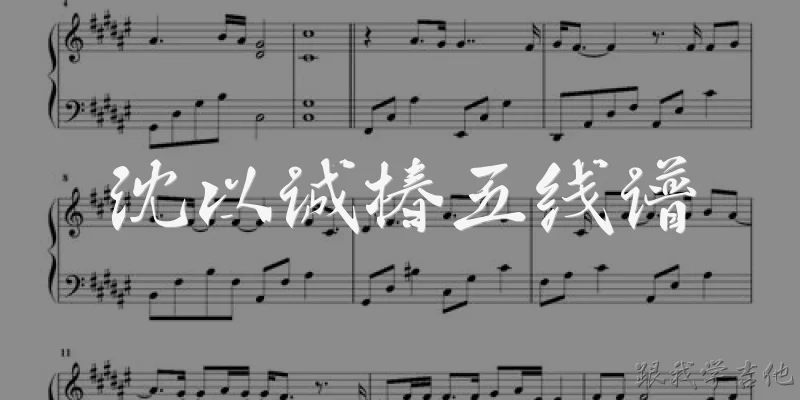
Shen Yicheng Chun Staff Notation:What is Shen Yicheng Chun Staff Notation and how does it differ from standard Western staff notation?
Q: What is Shen Yicheng Chun Staff Notation and how does it differ from standard Western staff notation?
A: Shen Yicheng Chun Staff Notation is a specialized musical notation system developed by the Chinese composer and music educator Shen Yicheng. It adapts Western staff notation to better suit the performance of Chinese traditional music, particularly genres such as Qin, Kunqu, and Jiangnan Sizhu. Unlike standard Western staff notation, which uses a five-line staff and fixed pitches based on equal temperament, Shen Yicheng Chun Staff Notation incorporates elements of Chinese musical theory, including flexible intonation, characteristic ornaments, and regional stylistic markers. It often uses additional symbols to indicate sliding tones, vibrato, and specific plucking or bowing techniques that are essential to Chinese instruments like the erhu, pipa, and guqin. The notation also preserves the oral traditions of Chinese music by integrating performance instructions that would otherwise be passed down by rote. This hybrid system allows musicians trained in Western notation to access Chinese repertoire more accurately, while also providing a written framework for improvisation and expressive nuances that are central to Chinese musical aesthetics.
Q: Who can benefit from learning Shen Yicheng Chun Staff Notation and what are its practical applications?
A: Shen Yicheng Chun Staff Notation is particularly beneficial for several groups: Western-trained musicians who wish to perform Chinese traditional music authentically, Chinese musicians who want to notate and preserve their heritage in a systematic way, and music educators teaching cross-cultural courses. Practically, this notation system is used in conservatories in China and abroad for courses on Chinese instrumental performance, ethnomusicology, and composition. It allows composers to write new works that blend Chinese and Western idioms without losing the subtle inflections of Chinese music. For performers of instruments like the guzheng, dizi, or pipa, the notation provides precise yet flexible instructions for techniques such as glissando, tremolo, and harmonic nodes. Additionally, scholars use it to transcribe historical recordings and folk tunes, making them accessible for analysis and reinterpretation. By learning this notation, musicians can bridge the gap between oral tradition and written score, enhancing both preservation and creative innovation. Its practical applications extend to film scoring, world music fusion, and pedagogical materials for students at intermediate to advanced levels.
Q: How does Shen Yicheng Chun Staff Notation handle the concept of 'pitch bending' or 'portamento' typical in Chinese music?
A: Shen Yicheng Chun Staff Notation addresses pitch bending and portamento through a set of dedicated symbols and notational conventions that go beyond standard Western staff notation. In Chinese music, sliding tones—such as the 'huayin' in erhu or the 'rouxian' in guqin—are not mere ornaments but structural elements. Shen's system uses curved lines, arrows, and small noteheads to indicate the direction, speed, and target pitch of a slide. For example, a diagonal line between two notes can show a smooth glide, while a wavy line may indicate vibrato or a microtonal oscillation. The notation also specifies whether the slide should be performed before, on, or after the beat, which is crucial for stylistic accuracy. Furthermore, it incorporates regional markers that distinguish, say, the sliding style of Cantonese music from that of Sichuan opera. This precision allows performers to reproduce the expressive nuances that are often lost when Chinese music is transcribed into conventional Western notation. By treating pitch bending as a first-class element, Shen Yicheng Chun Staff Notation offers a more faithful representation of Chinese musical phrasing and emotional depth.
Words of experience
Common scenarios of "Shen Yicheng Chun Staff Notation"
【Musicologist】 Hello, I've been researching Shen Yicheng's Chun Staff Notation. Could you explain what it is?
【Shen Yicheng】 Certainly. The Chun Staff Notation is a musical notation system I developed to simplify the reading and writing of music, especially for traditional Chinese instruments.
【Musicologist】 What inspired you to create this notation system?
【Shen Yicheng】 I found that standard Western staff notation can be cumbersome for Chinese music because it doesn't easily represent nuances like sliding tones or specific ornamentations. I wanted a system that integrates those elements.
【Musicologist】 How does it differ from other notation systems?
【Shen Yicheng】 Instead of using five lines, it uses a grid of squares. Each square represents a beat, and symbols within indicate pitch, duration, and playing techniques. It's more visual and intuitive for patterns common in Chinese music.
【Musicologist】 Can you give an example of how a specific technique is notated?
【Shen Yicheng】 Sure, for a glide or portamento, I use a curved line connecting two notes, similar to Western notation, but I also add a small arrow to indicate the direction and speed of the slide.
【Musicologist】 Is it widely adopted?
【Shen Yicheng】 It's gaining popularity among some contemporary Chinese composers and performers, but it's not yet mainstream. I'm working on teaching it in workshops.
【Musicologist】 What are the challenges in learning it?
【Shen Yicheng】 The main challenge is that it requires a shift in thinking from traditional staff notation. But once musicians grasp the grid concept, they find it very efficient.
【Musicologist】 Have you published any materials on it?
【Shen Yicheng】 Yes, I've written a book titled 'Chun Staff Notation: A New Approach to Chinese Music Notation' and there are online resources as well.
【Musicologist】 How does it handle polyphonic music?
【Shen Yicheng】 For polyphony, I use multiple grids stacked vertically, each representing a different voice or instrument. Alignment is indicated by vertical lines.
【Musicologist】 What about rhythms that are not strictly metered?
【Shen Yicheng】 I include free rhythm sections where the grid is replaced by a continuous line with symbols indicating approximate durations. This allows for flexibility.
【Musicologist】 Do you see potential for it to be used beyond Chinese music?
【Shen Yicheng】 Absolutely. It can be adapted for any music that requires detailed expression of pitch bends and microtones, such as Indian or Middle Eastern music.
【Musicologist】 Thank you for the insight. I look forward to seeing how it evolves.