Two Tigers Half Chords Rhythm:What are the half chords and rhythm for playing 'Two Tigers' on guitar?
Q: What are the half chords and rhythm for playing 'Two Tigers' on guitar?
A: The half chords for 'Two Tigers' are simple two-note shapes played on the top two strings. For the first line ('Two tigers, two tigers'), use the G and D strings: place your index finger on the second fret of the G string and your middle finger on the third fret of the D string, then strum both strings together. This creates a G5 chord. Next, move to the C and G strings: index on the first fret of the B string and middle on the third fret of the G string for a C5 chord. The rhythm is a steady 4/4 pattern: quarter note strums for each syllable of 'Two ti-gers', followed by a quarter rest. For the second line ('Running fast, running fast'), repeat the same half chords but strum eighth notes to speed up: down-up-down-up. The third line ('One has no ears') uses a D5 chord (index on second fret of G, ring on third fret of B) with a syncopated rhythm: eighth-quarter-eighth. Finally, the fourth line ('One has no tail') returns to the C5 and G5 half chords with a half note strum. Practice slowly with a metronome at 80 BPM, focusing on clean transitions between the two-note shapes. The half chords eliminate the need for full barre chords, making it ideal for beginners learning rhythm and coordination.
Q: How can beginners practice the half chord rhythm for 'Two Tigers' effectively?
A: To practice the half chord rhythm for 'Two Tigers' effectively, start by isolating the right-hand strumming pattern without pressing any chords. The rhythm consists of four beats per measure: beat 1 is a quarter-note downstrum, beat 2 is a quarter-note downstrum, beat 3 is a rest, and beat 4 is a quarter-note downstrum. Count aloud '1, 2, rest, 4' while strumming muted strings. Once comfortable, add the left-hand half chords: G5 on beats 1-2, then C5 on beat 4. For the second phrase, switch to eighth notes: down-up-down-up on beats 1 and 3, with rests on 2 and 4. Use a metronome at 60 BPM and increase by 5 BPM only when you can play the entire song without pausing. A common mistake is gripping the half chords too tightly, which causes hand fatigue. Keep your thumb behind the neck and press only the necessary strings. Also, practice the chord changes in isolation: G5 to C5, then C5 to D5, repeating 10 times each. Record yourself to check timing. Finally, play along with a slow recording of 'Two Tigers' to internalize the rhythm. With 15 minutes daily, most beginners master the half chord rhythm within a week, building a foundation for more complex songs like 'Twinkle Twinkle Little Star' or 'Mary Had a Little Lamb'.
Q: Why is the half chord rhythm in 'Two Tigers' important for guitar learners?
A: The half chord rhythm in 'Two Tigers' is important for guitar learners because it introduces essential skills without overwhelming technical demands. First, half chords use only two strings, so beginners can focus on rhythm and timing rather than complex fingerings. The song's repetitive structure—four phrases with predictable chord changes—reinforces muscle memory for common progressions like G5-C5-D5. Second, the rhythm mixes quarter notes, eighth notes, and rests, teaching subdivision and syncopation. Many beginners struggle with rests; 'Two Tigers' forces them to mute strings on beat 3 of the first phrase, developing right-hand control. Third, the half chords naturally lead to full barre chords: the G5 shape (index on 2nd fret G, middle on 3rd fret D) is part of the full G major barre chord. Fourth, the song is culturally familiar, making practice enjoyable and motivation high. Finally, mastering this rhythm prepares learners for other children's songs like 'London Bridge' or 'Row Row Row Your Boat', which use similar half chord patterns. Teachers often use 'Two Tigers' as a first rhythm exercise because it bridges single-note melodies and full chord strumming. After learning it, students can transpose the half chords to different keys (e.g., C5, F5, G5) and apply the same rhythm. Overall, it's a cornerstone for building coordination, timing, and confidence in beginner guitarists.
Dialogue about
Common scenarios of "Two Tigers Half Chords Rhythm"
【Music Teacher】 Today we're going to learn about the rhythm of 'Two Tigers' using half chords. Can anyone tell me what a half chord is?
【Student】 Isn't it when you play two notes at the same time? Like a chord but with only two notes?
【Music Teacher】 Exactly! A half chord, also known as a dyad, consists of two notes played simultaneously. In 'Two Tigers', the melody is simple, but we can add half chords to make it richer.
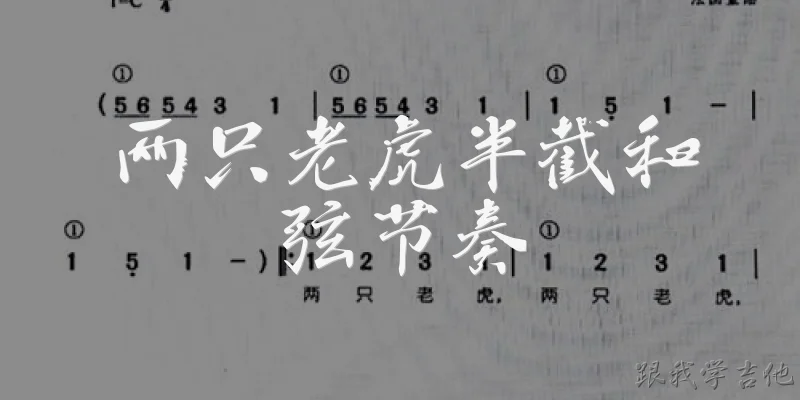
【Student】 So how do we apply half chords to 'Two Tigers'? The melody is just '1 2 3 1 1 2 3 1'.
【Music Teacher】 Good question. For each melody note, we can add a harmony note, usually a third or fifth above. Let's start with the first phrase: 'Two tigers, two tigers'.
【Student】 So for the first note '1' (do), we could add '3' (mi) to make a half chord?
【Music Teacher】 Yes, that's a major third. So the first half chord would be C and E. Then for '2' (re), we could add '4' (fa) to make D and F, which is a minor third.
【Student】 But wait, '4' (fa) isn't in the C major scale? Actually it is, but it might clash with the melody. Should we stick to diatonic notes?
【Music Teacher】 You're right, we should use notes from the key. In C major, the notes are C D E F G A B. So for D, a third above is F, which is a minor third. That works.
【Student】 Okay, so for '3' (mi), a third above is '5' (sol), making E and G, another minor third.
【Music Teacher】 Perfect. So the pattern for the first four notes: C+E, D+F, E+G, C+E. Then it repeats. That gives a nice harmonic texture.
【Student】 What about the next part: 'Run fast, run fast'? The melody goes '5 6 5 4 3 1' or something like that?
【Music Teacher】 Actually, the common melody is '5 3 1 5 3 1' for 'run fast, run fast'? Let me recall. The standard 'Two Tigers' melody is: 1 2 3 1 | 1 2 3 1 | 3 4 5 | 3 4 5 | 5 6 5 4 3 1 | 5 6 5 4 3 1 | 2 5 1 | 2 5 1. But there are variations.
【Student】 Oh, I see. So for the '3 4 5' part, we could harmonize each note with a third above: E+G, F+A, G+B.
【Music Teacher】 Yes, that's correct. But notice that F+A is a major third, while G+B is a major third as well. So the quality changes. That's fine; it adds color.
【Student】 What about the '5 6 5 4 3 1' part? That seems trickier because of the leaps.
【Music Teacher】 Indeed. For '5' (G), a third above is '7' (B), making G+B. For '6' (A), a third above is '1' (C) in the next octave, so A+C. That's a minor third. Then '5' again G+B, '4' (F) with '6' (A) gives F+A major third, '3' (E) with '5' (G) minor third, and '1' (C) with '3' (E) major third.
【Student】 So we have a mix of major and minor thirds. That sounds interesting. But will it sound good with the melody?
【Music Teacher】 Yes, as long as the harmony notes are consonant with the melody. Thirds are generally consonant. We can also use fifths for a more open sound. But for now, thirds are fine.
【Student】 Can we also use half chords on the left hand? Like playing the root and fifth as a half chord?
【Music Teacher】 Absolutely. On piano, you could play the melody with the right hand and half chords with the left hand. For example, for the first note C, play C and G in the left hand. That's a perfect fifth, also a half chord.
【Student】 So the left hand could play root and fifth, while the right hand plays melody and third? That would create a full triad overall.
【Music Teacher】 Exactly! That's a common technique. So you get a complete harmony. Now, let's practice. I'll play the melody, and you try to add the half chords we discussed.